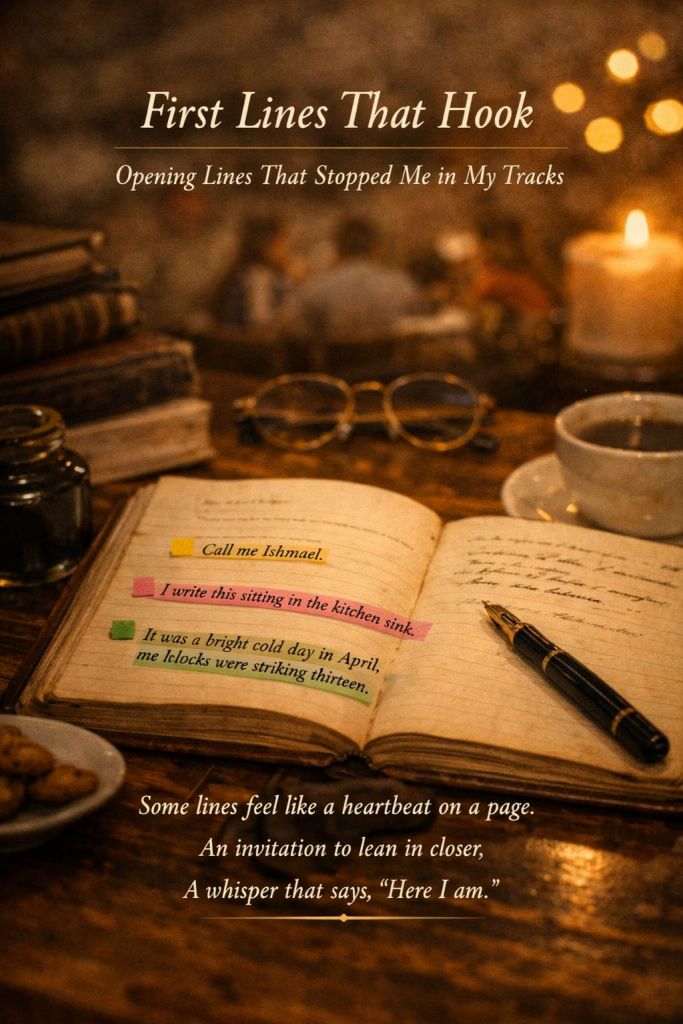
Some first lines do more than just grab your attention. They stop you mid-way through scrolling, or taking a sip of your drink, or simply thinking!
I’ve been hooked on first lines that capture an entire universe in a single sentence. A first line is not only an introduction. It’s also an invitation. It’s a soft voice saying “Come closer.”
At times it’s the rhythm of the line that speaks to me. At other times it’s the frankness of the line I’m hearing. That one line felt like it had been created with me in mind.
I recall one first line I stumbled across, and I didn’t just think it’s a book. I thought it was life. That is what remarkable first lines accomplish. They begin a dialogue between the author and reader through the writer’s words. And, as such, they are the starting point for a dialogue between the reader and writer.
And I think that is why I have a collection of first lines like other people have souvenirs. Each one is proof that the beginning is important, because they are the ones with the courage to say, “This is Me”.
Literary festivals are not mere assemblies of words but worlds come together. Each dialogue felt like stepping into someone else’s imagination.
Here, I understood that stories did not necessarily come to an end on the closing page but extended further in the quiet of the reader’s heart. Here, I saw that every writer possesses courage along with doubt. But both were needed for writing the truth.
Amidst panel discussions and tea/coffee breaks, my only mission seemed to be collecting echoes – the laughter of a poet, the revelation of a translator, the silent consent of a reader. All these moments made me understand that literature was more about the connection of words than perfection, as it connected us through words and hearts regardless of languages and times.
And maybe this was the true message: It was never about learning how to write but remembering why.
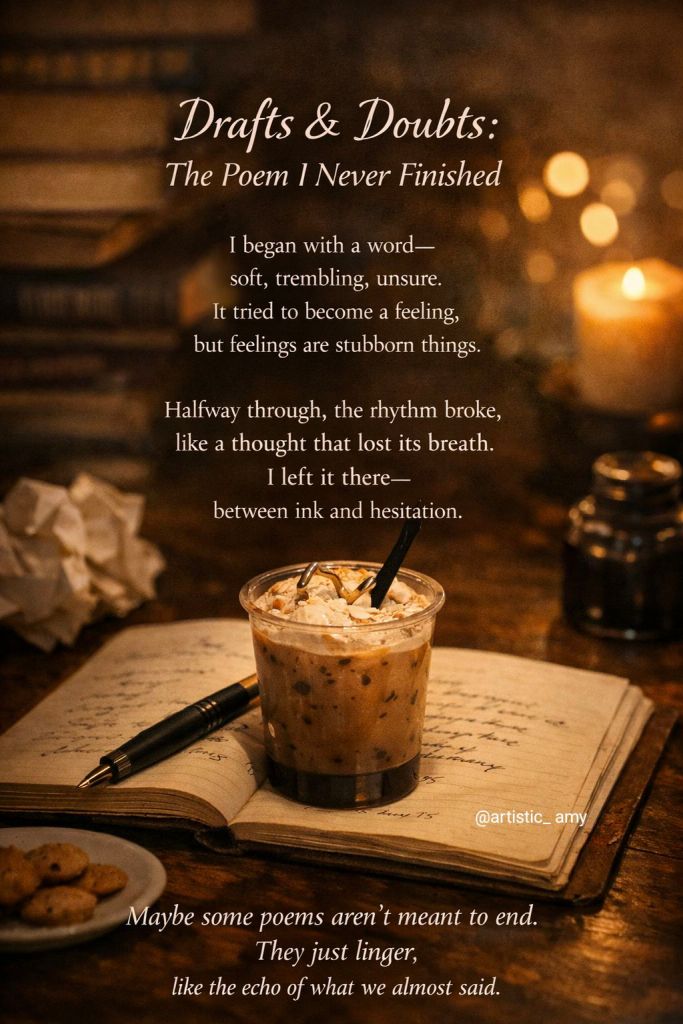
We met for the second time, once again playfully teasing each other. When our friend ordered two coffees he leaned in with a cheeky expression “Let’s share!”
So, there we were…one coffee with one straw…created one memory. He took the first sip, eyes sparkling as he indulged in pure joy, then passing it to me—sharing both the experience of coffee and friendship at the same time!
I could not finish it. I quietly lifted the straw and set it aside. When he noticed he smiled and drank the rest without saying a word—neither one of us needed to say anything we both understood it on a deeper level.
Sometimes love doesn’t need words…it may be found in tiny acts of kindness—such as sharing a straw.
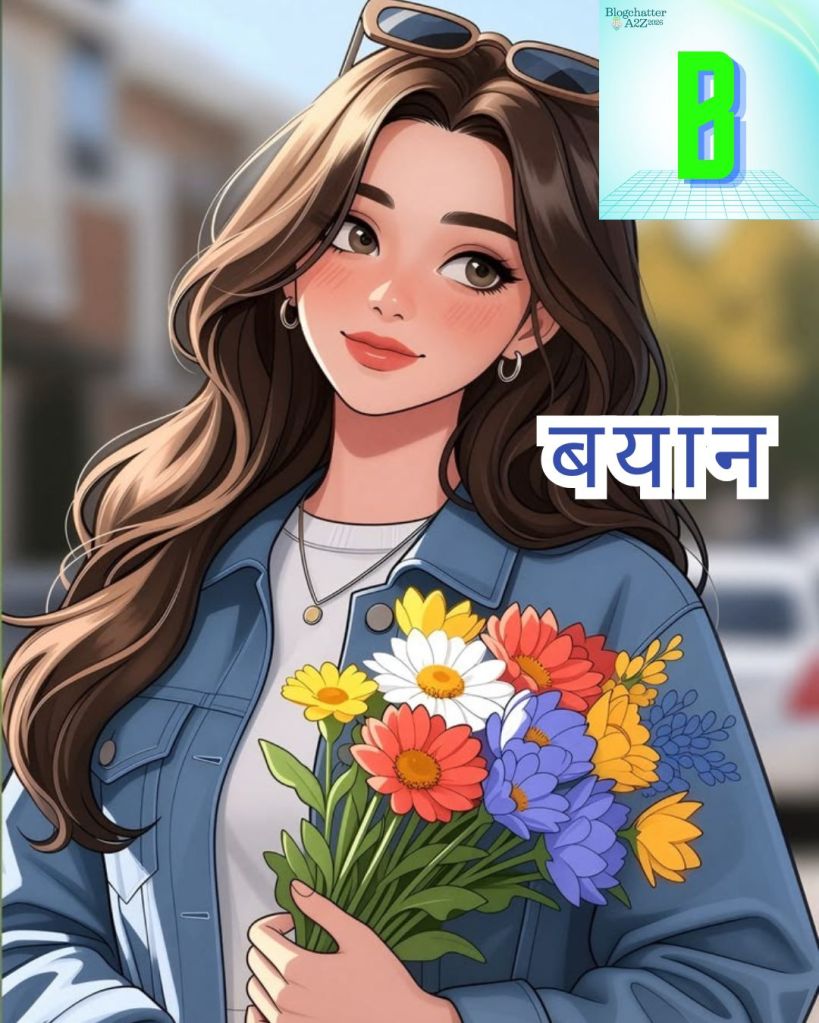
बयां करती हूँ में बीते दिनों की कहानी, बिखरे लम्हों में तुम्हारी यादें पुरानी। ख़्वाबों में भी तुम रोज़ आते हो मेरे, देने अपनी बाहों का सहारा। I’m Participating in #BlogchatterA2Z https://www.theblogchatter.com
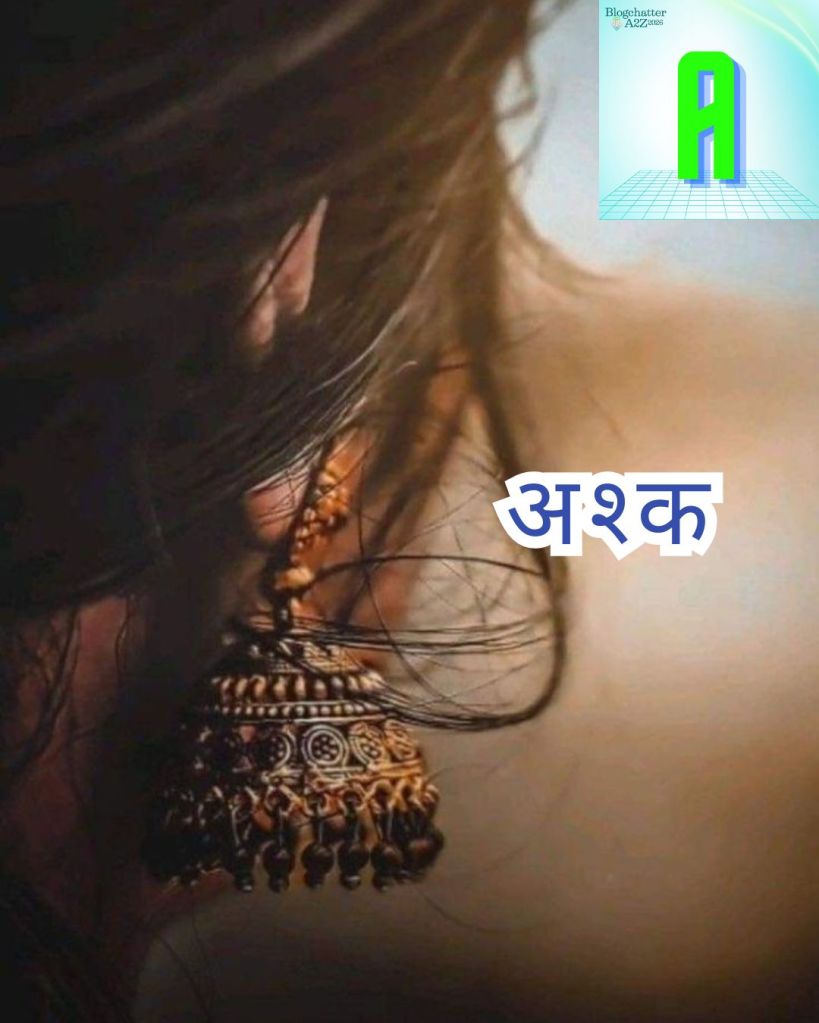
तेरी यादों में बहते हैं अश्क़ मेरे, हर बूंद में छुपा है इश्क़ तेरे लिए। रात की ख़ामोशी में भी तेरा नाम गूंजता है दिल में, ना जाने क्यूं जुड़े हैं मेरे दिल के तार तुझसे दिल की धड़कन भी तुझसे ही जुड़ती है मेरी।
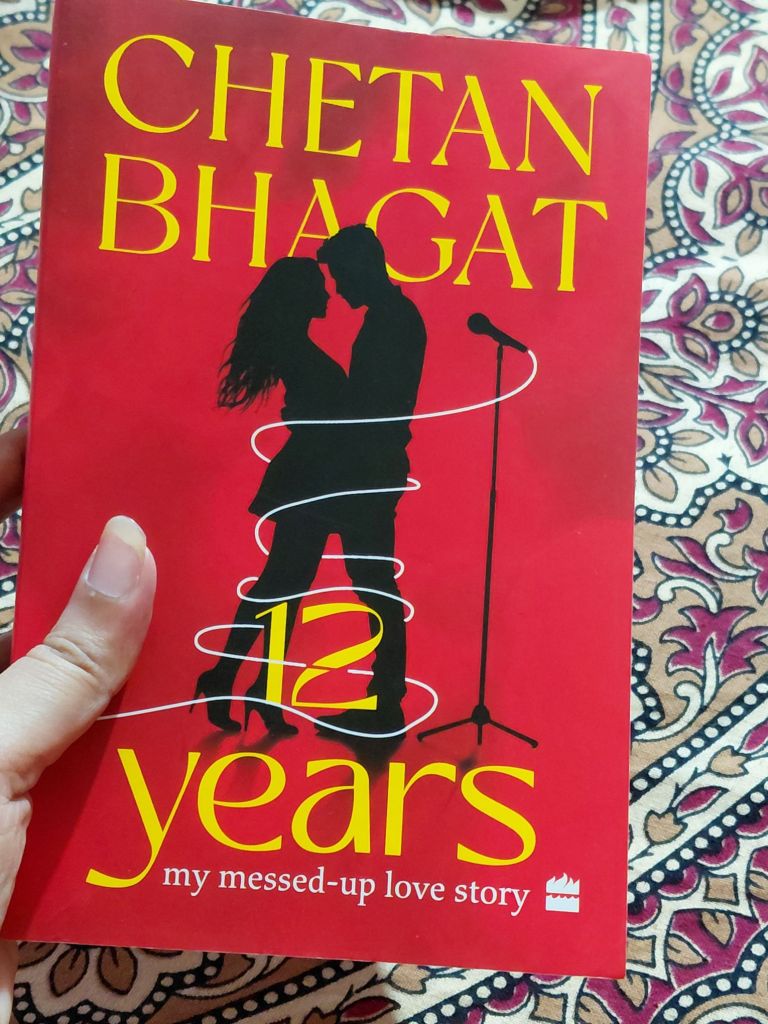
“12 Years: My Messed Up Love Story” by Chetan Bhagat is a fast-paced romance novel that revolves around two lovers whose love life gets complicated due to age differences and emotional issues. This novel is unapologetically Chetan Bhagat; it does not hold back when it comes to drama and crazy situations.
Introduction:
The latest novel by Chetan Bhagat, “12 Years: My Messed Up Love Story,” is a contemporary Indian romance novel that delves deep into the complexities that surround love in different generations. The novel is about a 33-year-old Saket Khurana, who at the point of writing this novel is a 33-year-old man and a former successful finance professional, but now has chosen to leave that life behind and become a stand-up comedian, and a young girl named Payal Jain, who is 21 years old, an upcoming private equity executive from a traditional and conservative Jains’ family. The two of them fall in love with each other in Mumbai. The tone and themes of the story are portrayed in three different manners:
1. The age gap of twelve years between Saket and Payal portrays the differences between them (culture, emotional, mental, etc.). Not only because of the age gap, but also the possibility to portray the differences between generations of Millenials and Gen Z, all from an author’s perspective.
2. The themes of family expectations, traditional Indian beliefs about marriage, gender roles, and family honor are all there in the book.
3. Saket has numerous emotional issues because of the societal pressure of relationships after his divorce, whereas Payal has even more guilt and emotional issues with her childhood as she discovers herself now that she has rejected her upbringing. This section compares the writing style of the authors to other authors in the same genre and has many different opinions on how people feel about Bhagat.
It is believed that the writing style of Chetan Bhagat makes the novels easier to understand, but he is also dramatized and unrealistic about some parts of a male’s life. Some people believe that he has written about some far-fetched events in a man’s life.
In the second phase, the critics want to criticize Bhagat for the masculine tone of his book, but Bhagat justifies his masculine tone because of the importance of reality vs. the importance of being politically correct. The third phase shows how the level of the waves in the plot of the book imitates the level of the waves in the reader’s feelings. Many people will want to be entertained by “high drama” in the plot of the book. Both Payal and Saket have their “AHA!” experiences in the climax of this novel. Payal conveys her turmoil of emotions as a result of being torn between the responsibilities and obligations that she has versus her emotions for Saket in a passive way compared to how Saket conveyed his emotions.
One of the main differences between Saket and Payal’s emotional condition can also be explained by the fact that Saket’s initial condition of emotional suffering is a result of his unrequited love for Payal and his capacity to gain peace in his own self through hope.
Conclusion: It is clear that the author of this novel, Chetan Bhagat, did a fantastic job of emotionally connecting with his readers in his novel. I think that it was necessary to reach all types of audiences through the use of relatable emotion; therefore, Chetan Bhagat decided to write this non-fictional book to assist the reader in comprehending their own emotions from reading this book, whether it be a regular or first-time book reader.
A lot of people get stuck in an endless thought loop of what could have been and that holds them back. The fear of these “what ifs” has been dealt with in a very practical way in this book. Rather than addressing “if” as a symbol of doubt, it teaches us to transform these “if” thoughts to identify potential and focus on action. By this simple application, you will be able to turn fear into motivation and indecision into positive growth. In this book, the authors have used practical tips, inspirational stories and easy tricks to help the readers take a step towards success. It also reminds the readers that we are capable of living a life without the negative “if” thoughts, if we choose wisely and act positively. This book is motivating and easy to understand and is a very helpful guide on how to create a purposeful, fulfilling and confident life. I’d rate this book 5/5✨
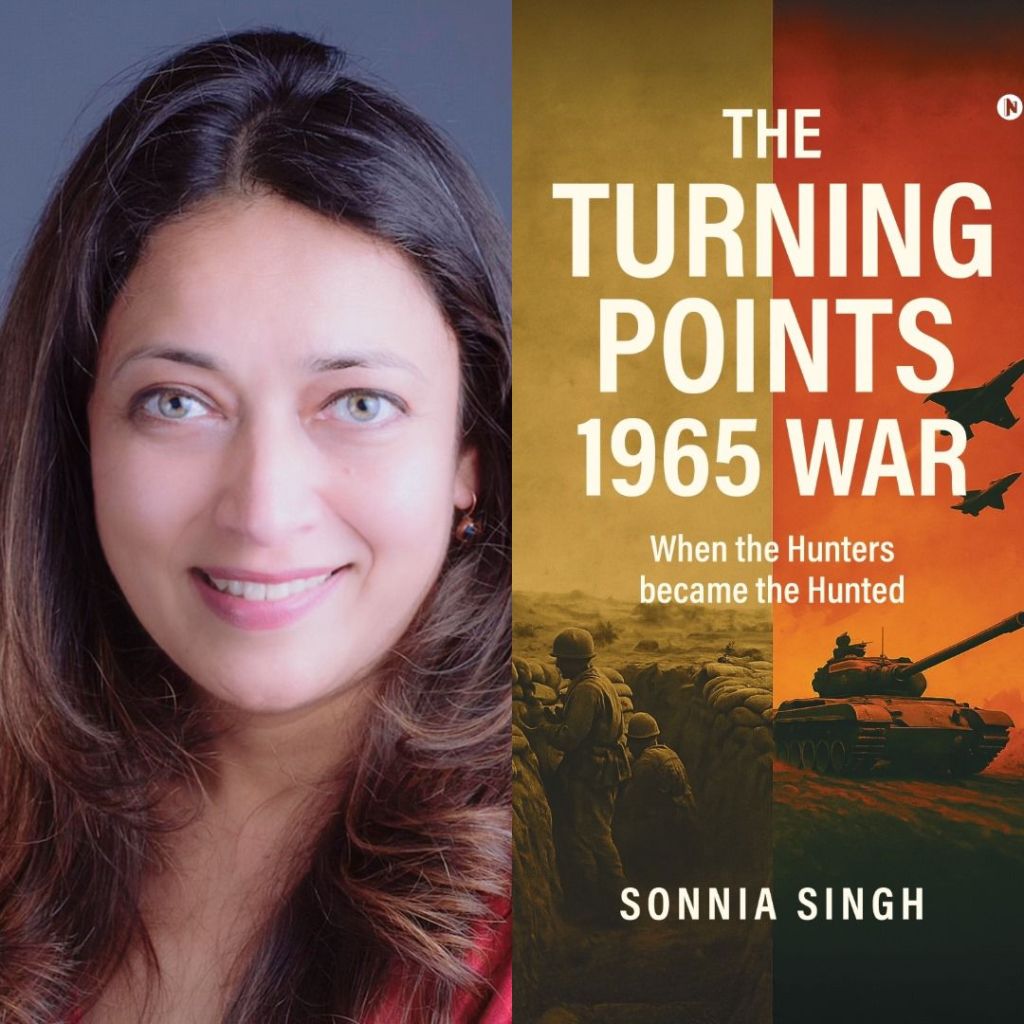
The India–Pakistan War of 1965 was not just a clash of arms, but a test of a young nation’s soul. Less than two decades after gaining independence, India found itself pushed to a war not of its seeking – its fate hanging by a thread as battles raged across The Rann of Kutch to the Mountains of Pir Panjal and culminated in the fields of Punjab. It was a time when history could have broken in an entirely different direction, but through grit and courage the young nation rewrote destiny through audacity and defiance. In The Turning Points: 1965 War, Sonnia Singh captures this tumultuous moment in history with a rare sensitivity. She takes you inside the moments when history itself hung in balance — when the courage of a few turned the tide
What sets this book apart is its heartbeat. Ms. Singh does not drown the reader in cold figures or dry timelines. Instead, she invites us into human stories that carry the grit and rawness of lived experiences. Through the battle terrains she introduces us to soldiers who held their ground against impossible odds, commanders who made decisions in moments that could have ended in disaster, and an air force that dared to strike deep into enemy territory when hesitation would have been easier. You walk beside Maj. Ranjit Dayal as he scales the impregnable Haji Pir Pass. You feel the tension as Lt. Col. Desmond Hayde takes Dograi — not once, but twice. You hear the roar of tanks in the fields of Khemkaran, where India’s so-called “outdated” machines transformed the world’s most modern Pattons into burning hulks at Assal Uttar. And you soar with the Indian Air Force as it dares the unthinkable — striking Sargodha, the pride of Pakistan’s air power, in broad daylight. But Sonnia does not shy away from the shadows. She confronts the missteps, the divisions in command, and the political hesitations that almost squandered these hard-won victories. That honesty gives the book its power. The glory of 1965 shines brighter because it was never guaranteed. Every success was clawed back from the edge of disaster.
Woven through every page is the theme of leadership. Lt. Gen. Harbaksh Singh’s unwavering steadiness. Air Chief Arjan Singh’s audacious vision. The resilience of soldiers who fought knowing they were outgunned, but never outwilled. These are not distant figures frozen in history books. Sonnia brings them close — leaders whose choices under fire carry timeless lessons for anyone who dares to lead today.
The story of this book began, fittingly, with a moment of remembrance. A visit to the Ahmednagar Tank Museum. A father’s quiet correction. A daughter’s realization that the names and battles etched on steel were not relics, but lifelines of a nation’s freedom. That spark ignited two years of research, interviews with veterans, and an unwavering mission: to ensure that these turning points — these fragile, decisive instants — would never fade into obscurity.
Though the war ended with a ceasefire, often labeled “inconclusive,” Sonnia makes the case that 1965 was, in truth, a victory — of spirit, of strategy, of courage. India stopped at Lahore not because it could not advance, but because it chose restraint. That choice itself was strength.
Now, as the 60th anniversary of the war commerates this September, The Turning Points: 1965 War is more than a book. It is a tribute, a remembrance, and a call to reflection. It asks us to honour the men who never came home, to recognize the leaders who carried impossible burdens, and to remember that courage is not history — it is a living inheritance.
This is a book for those who believe leadership is forged in fire. For those who want to understand not just how wars are fought, but how nations are shaped. And for every reader who knows that freedom is never free.
The Turning Points: 1965 War is available now in Amazon and the Notionpress Store.







 Amanyas Creative World